Let's dive into the fascinating differences and similarities between flamenco guitar and fingerstyle.
If you’re a fingerstyle guitar enthusiast, you’ve likely heard of flamenco guitar, and you may have attended a concert where a guitarist was plucking away in the characteristic and immediately recognizable style of flamenco.
Or, you may have encountered flamenco guitar through one of the many artists who practice the fusion between flamenco and modern guitar playing.
Indeed, although Flamenco guitar derives its origins from a specific type of folk tradition from the south of Spain, its gypsy flavors have inspired guitarists from all genres of music, especially fingerstyle guitar.
But what's the difference between fingerstyle and flamenco guitar? Clearly, both fingerstyle guitar and flamenco guitar are played finger picking, that is, without a pick.
But beyond the obvious differences and similarities lies some surprising elements that you may not have thought of. And learning about them could help you improve your fingerstyle playing.
Let's start by learning what flamenco guitar is all about, before diving into the similarities and differences of the two styles.
Fingerstyle vs. Flamenco: What's The Difference?
The main difference between flamenco and fingerstyle guitar is traditionally, flamenco guitar is primarily for accompanying singers and dancers, whereas fingerstyle guitar is primarily a solo genre and usually doesn't include singing.
Flamenco guitar is steeped in folk music tradition from the south of Spain and its gypsy colours have inspired guitarists from all genres of music, especially fingerstyle guitar.
What is Flamenco Guitar?
Although many guitarists equate the flamenco genre with a type of guitar or a specific style of playing, flamenco actually started out as a dance. As the art evolved in the province of Andalusia in Southern Spain, singing was added later, and finally the guitar completed the trio.
Origins of Flamenco guitar playing
So, flamenco guitar is actually the last step in the evolution of the folk art known as flamenco. This brings us to the first difference with fingerstyle guitar, which derives its origins from classical guitar and popular music genres such as jazz and blues.
The origins of modern fingerstyle guitar are easily traced back through time. This stands in sharp contrast to flamenco guitar, whose origins remain deeply mysterious and rooted in folklore. In fact, the lack of certainty surrounding the beginning of flamenco is valued and carefully preserved.
Flamenco guitarists have sought to maintain this mystery through their performances and transmission of the art form through face-to-face instruction rather than recorded means.
Evolution of flamenco guitar
As flamenco rose in popularity to become a worldwide phenomenon, flamenco guitarists became more specialized, and in doing so they began to expand their technique.
At the same time, Spanish composers such as Manuel de Falla, who were interested in the folk traditions of their country, began to incorporate elements of flamenco into their music.
Finally, brilliant recording artists like Paco de Lucía brought the style of flamenco guitar into the mainstream, through their brilliant solo concerts and recordings.
Influence of flamenco on fingerstyle
For instance, flamenco guitar has clearly influenced Sungha Jung in his song Flaming, where he successfully incorporates both harmonic and percussive elements from flamenco guitar into his music.
What Are The Similarities Between Flamenco and Fingerstyle Guitar?
As we pointed out, both flamenco guitarists and finger pickers play exclusively with their fingers, and never with a pick.
And flamenco musicians play on a modified classical guitar, whereas fingerstyle guitarists normally use a steel string acoustic guitar.
Let's look at some more similarities which go beyond the obvious.
Use of percussion in flamenco guitar
One of the more noticeable similarities between fingerstyle and flamenco is the use of percussion.
Flamenco guitarists often use golpe, a percussive effect which involves striking the soundboard of the guitar underneath the strings between the bridge and the soundhole with the fingertip of the plucking hand (usually the ring finger).
The heavy and nearly constant use of this aggressive percussive technique is why flamenco guitarists will protect their instrument with a sheet of plastic known as a golpéador.
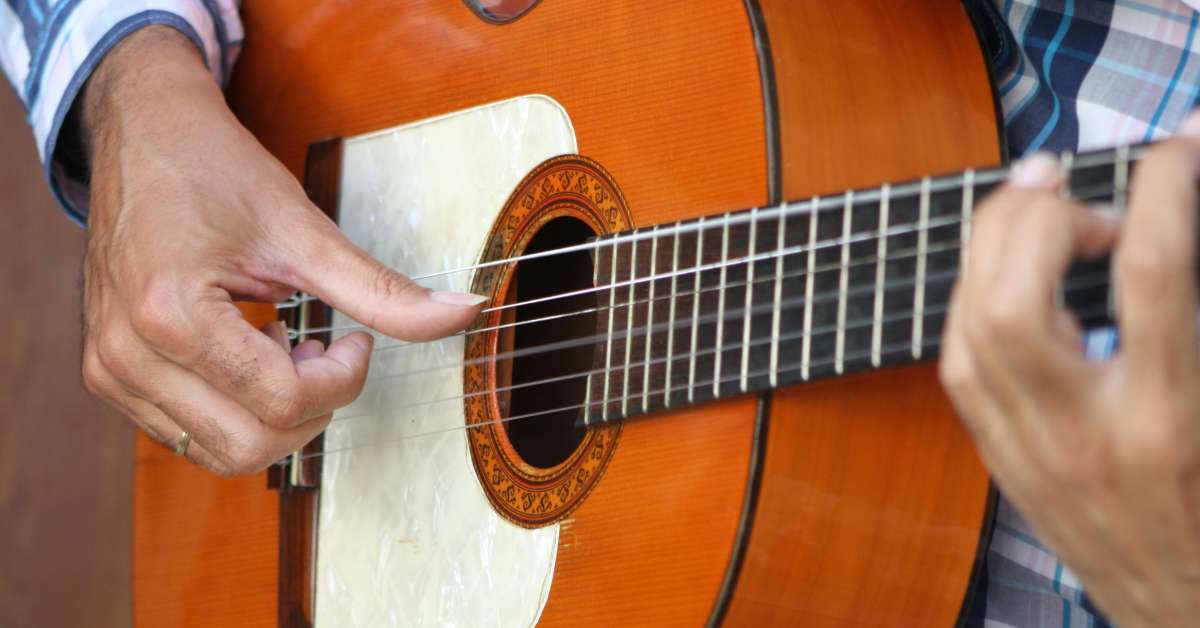
On the other hand, some famous fingerstyle guitarists aren't bothered by having holes or scratches in their instruments, instead using these characteristics to their advantage. For example, lightly rubbing your fingers in a circular, rhythmic pattern across the top of an acoustic guitar which has lost some of its finish can produce a sound similar to using wire brushes on the snare drum.

We'll talk about the importance of golpé in flamenco guitar a little later on, when we look at the differences between fingerstyle and flamenco.
Timbre or tone quality
Another big similarity between flamenco guitar and fingerstyle is the emphasis on a brighter sound. Both flamenco and fingerstyle guitarists aim to produce a brilliant sound from their guitars, as opposed to a classical guitarist who favours a more mellow tone.
Fingerstyle guitarists get this brighter sound from their choice of instrument, which is usually a steel string guitar. Flamenco guitarists, on the other hand, favour a technique known as rasgueado which involves striking the strings with the fingernails.
On the other hand, flamenco guitar players value a clean tone production, without embellishments such as chorus or reverb added to enhance the amplified sound. This contrast is further enhanced with fusion recordings, where the natural nylon sound of the flamenco guitar is in contrast with the brilliant timbre of the metal string guitar.
Sitting posture
You might also notice some fingerstyle guitarists who adopt the same posture as flamenco guitarists, which involves raising the right leg by resting it on the left lap, and not using a footstool or a guitar strap.
Sungha Jung adopts the posture of a flamenco guitarist when playing fingerstyle and it appears he can sit like that for long periods of time.

I'm not sure how he does it, frankly!
What Are Some Differences Between Fingerstyle and Flamenco?
The most obvious difference is the choice of instrument: as we saw earlier, flamenco guitarists use a specialized, nylon string guitar whereas fingerstyle guitarists use a heavier acoustic instrument.
But let's get back to percussion, because therein lies the most surprising difference between flamenco and fingerstyle.
Use of percussion in fingerstyle guitar
In fingerstyle guitar, we will often use a larger variety of percussive effects, such as thump slaps and wrist bumps. We also strike other parts of the guitar, not just the soundboard.
But flamenco guitarists stick to use of golpé, which is extremely important in flamenco.
Flamenco guitar music is centered around a rhythmic element known as compás, whereas the primary importance of fingerstyle guitar is the melodic line and harmonic accompaniment.
Because flamenco guitarists must accompany singers and dancers, the rhythmic element is an integral part of their playing. In fingerstyle guitar, we can use percussion as an ornament, and percussive effects are not a requirement at all.
Use of fingernails
Flamenco guitarists must have long nails to play their style of guitar, and many of them choose to use fake nails. Although many fingerstyle guitarists, myself included, prefer to play with nails, playing without nails is relatively common among fingerstyle guitarists.
This is because flamenco guitarists emphasize the use of rest stroke and specialized techniques using the thumb, whereas in fingerstyle guitar you should be almost exclusively using free stroke.
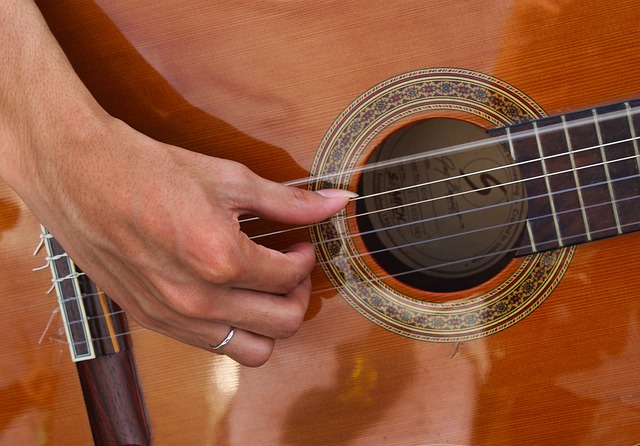
The specialized techniques in flamenco are needed to play the characteristic rhythmic patterns, whereas in fingerstyle guitar, we have more freedom in terms of technique.
For instance, flamenco guitarists don't use delicate effects such as cascading harmonics, instead focusing on rhythmic elements like rumba strumming patterns.
Improvisation and stylistic elements
If you are a fingerstyle or classical guitarist, you probably learn most of your music from reading sheet music or tablature, such as from my high quality tabs.
But traditionally, the flamenco guitar is taught and learned by listening, not through written documents.
This is because flamenco guitar places a huge emphasis on improvisation and imitation.
Thus, whereas a classically trained guitarist can play a fingerstyle arrangement of popular songs usually without having heard the music beforehand, this is almost impossible to do with flamenco guitar.
Nowadays, with everything available on YouTube and with the complexity of our modern music, I recommend listening to a recording of anything before learning it.
Is Fingerstyle Guitar Harder Than Playing Flamenco Guitar?
No, fingerstyle guitar isn’t necessarily harder than playing flamenco guitar. Both techniques have various degrees of difficulty. There are very easy and very difficult fingerstyle songs, just as there are easy and difficult flamenco pieces that you can play.
With fingerstyle guitar, you will specialize in playing melody and bass lines at the same time. But the focus of flamenco guitarists is on rhythm and fast scales.
Playing fingerstyle guitar opens you up to the possibility of learning flamenco. And although there are some surprising differences between the two genres that we just explored here, learning just the basics of fingerstyle guitar will give you a huge advantage when it comes to immersing yourself into flamenco guitar.
It's easier to learn a wider variety of music, from classical and folk to jazz and blues, if you start with fingerstyle guitar. If you are just getting started, I recommend my complete online course Play Fingerstyle Guitar Now!