Here's a guide to understanding how beats are organized in music.
Are you confused about the difference between simple and compound meter? Or perhaps you are curious about the typical pattern of strong and weak beats in a meter of music?
Indeed, simply treating each beat of music as if it were identical is a fundamental misunderstanding of the hierarchy of musical rhythm.
Our natural body rhythm lets us enjoy music, and helps us to tap and clap along with the beat. But this body rhythm also imposes a structure on how certain beats are emphasized.
Let's learn more about how to give music its distinctive feel and groove.
What Are Strong And Weak Beats?
In music, the beats inside a measure can be strong or weak. The first beat of the group of beats inside of a measure is always a strong beat. The weak beat (or beats) is either the next beat in a grouping of two beats, or the next two beats in a grouping of three beats.
For example, in 4/4 time, the strong beats are the first beat of a measure, and the third beat of the measure. The weak beats in 4/4 time are the second and fourth beat in 4/4 time.
In 3/4 time, the strong beat is the first beat, and the weak beats are the second and third beats. In 3/4 time, the weak beats receive much less emphasis than the strong beat, such that we can sometimes count measures of 3/4 time using only the first beat.
Counting Beats In Music
Each of the beats inside the measure are assigned a number, and the total number of beats inside the measure is indicated by the top number of the time signature. The top number in a time signature is usually 3, 4 or 6, but it can be any number between 1 and 15. Numbers beyond 16 are possible but extremely rare.
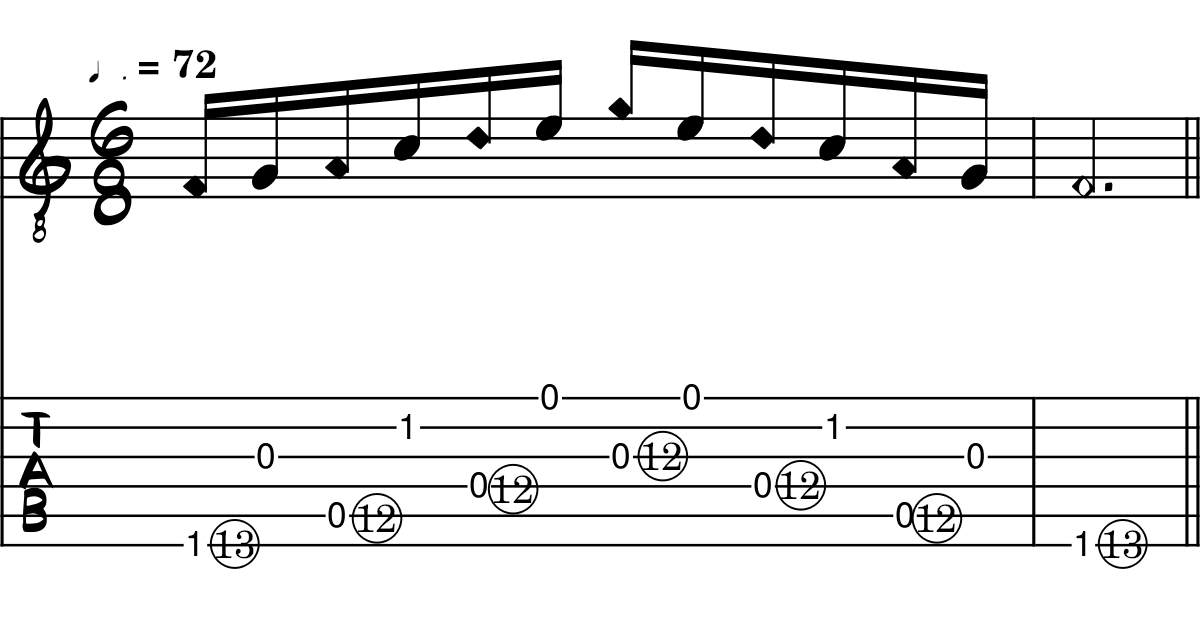
When you subdivide each of these beats in the measure, they are weaker still than the strong or weak beats discussed. In fact, when counted, we do not even assign a number to these subdivisions, but instead a syllable or word like & (and) or "a".
If all this sounds confusing, let's step back and define some terms in music to clarify what we've just discussed.
What Is Meter In Music?
Meter in music refers to how beats or pulses are organized in music. Beats occur at regular intervals, and we can group them together based on the musical events occurring in the song.
Our natural body rhythm dictates how we group together beats in music. Most of our music is based on groupings of two or three beats which occur at regular intervals. Irregular groupings such as 5 or 7 beats are rare in Western music, but found in other styles such as Balkan music.
Meter or Time Signature
The meter, or time signature, is a symbol at the beginning of a piece of sheet music. The strong and weak beats in a measure are determined by the time signature.
The time signature contains two numbers. The top number represents the number of beats in a measure. The bottom number shows the type of note that represents one beat. Common time signatures include 4/4, 3/4, and 6/8.
In 4/4 time, also known as common time, there are four beats in a measure and a quarter note represents one beat. In 3/4 time, there are three beats in a measure and a quarter note represents one beat. In 6/8 time, there are six beats in a measure and an eighth note represents one beat.
Beats And Note Values
The relationship between the beats and the note values, such as quarter or eighth notes, is determined by the time signature. In 4/4 time, for example, there are four beats in a measure and a quarter note equals one beat.
Also in 4/4 time signature, two eighth notes each also receive one beat, and four sixteenth notes equal one beat as well..
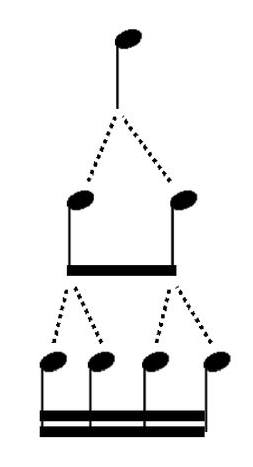
You will learn about time signatures in-depth in the online course Play Fingerstyle Guitar Now!

What's A Compound Time Signature?
With a compound time signature, the beats can typically be grouped together and you can count only the strong beats, especially at fast tempi or speeds.
In a compound time signature, such as 6/8 time or 12/8 time, each of the beats are grouped into three equal parts, with the first beat of the group getting the stress. Essentially, a compound time signature gives you the feeling of a triple meter inside of a double meter.
This means that you could count each measure of a compound time signature as if it only contained the strong beats, such that each beat is divided into three parts instead of two. This is distinct from a hemiola, which is an artificial grouping of six distinct notes which each have their own beat into groups of two or three units.
| Time Signature | Beats in 1st measure | Beats in 2nd measure |
|---|---|---|
| Regular 6/8 grouping | 1-2-3-4-5-6 | 1-2-3-4-5-6 |
| Regular 3/4 grouping | 1-2-3 | 1-2-3 |
| 3/4 with hemiola | 1-2-3 | 1-2-3 |
How to Count 6/8 Time Signature
In 6/8 time, there are six beats in a measure as indicated by the top number, and an eighth note represents one beat, as represented by the bottom 8. This means that the quarter note, which is typically worth one beat in 4/4 and 3/4 time, does not receive one beat in 6/8 time. A quarter note instead is worth two beats in 6/8 time, rather than one beat.
In 6/8 time signature, the emphasis is on the first and fourth beat, which are the strong beats. The second and third beats, as well as the fifth and sixth beats are the weak beats.
| Count | 1 | 2 |
|---|---|---|
| Beats | 1-2-3 | 4-5-6 |
How to Count 12/8 Time Signature
In 12/8 meter, there are twelve beats in a measure and an eighth note represents one beat. The beats are grouped into groups of three, with each group of three beats counted together.
This means that in 12/8 time, you don't have to count "1, 2, 3, 4, 5, 6, 7, 8, 9, 10, 11, 12" for each measure. Instead, you would group the counts into sets of three, like this:
| Count | 1 | 2 | 3 | 4 |
|---|---|---|---|---|
| Beats | 1-2-3 | 4-5-6 | 7-8-9 | 10-11-12 |
Notice that each count is made up of three beats. Sometimes, breaking down each beat into three parts can help with accuracy and timing. One way to keep track of beats in a compound time signature is by using three syllable words: "rasp-ber-ry blue-ber-ry straw-ber-ry mul-ber-ry" instead of counting all the way to 12.
Songs That Use 6/8 And 12/8 Time Signatures
The distinct groove that's created by the 12/8 time signature is familiar to anyone who loves blues or soul music. Sungha Jung is a South Korean acoustic fingerstyle guitarist who effectively uses 12/8 time in his songs "Kiss" and "The Milky Way".
In pop music are "Perfect" by Ed Sheeran uses the 12/8 time signature in his song Perfect and Taylor Swift uses the 6/8 time signature to great effect in the song Dear John.
Compound time signatures create a flowing, lilting rhythm that supports a slow melody such as a ballad. and adds a sense of movement to the piece. These songs can be challenging to play at first, but with practice, you can master the timing and fingerpicking patterns. If you are looking to improve your fingerstyle guitar playing, then the online course Play Fingerstyle Guitar Now! is a great place to start.