
Here's what you need to know in order to play guitar without peeping constantly at both hands.
When I was in Grade 3, we had to take a touch typing class, in order to learn how to type without looking at the keyboard. The teacher showed us how to type each letter one finger at a time, using the home row as a base.
Before long, I was able to type at a decent speed without having to glance at the keyboard. Later on, when learning guitar, I realized that the same skills that go into touch typing can also help you play guitar without looking.
But in order to speed up the process, there are some tips that will help you become even faster at playing guitar without looking at the fretboard or the strings. Here is how to play guitar without looking at your hands, so you can become a faster and more confident guitar player.
How To Play Guitar Without Looking
There are three global aspects to master in order for you to confidently play guitar without looking at either the strings or the fretboard. Since the primary focus of this resource is fingerstyle guitar, I'll focus on techniques that require plucking the strings with the right hand. Although you will have success porting these tips over to other styles of playing, such as flatpicking.
The first aspect involves developing a mental visualization or "internal map" of the guitar. The second aspect revolves around tactile information as feedback, instead of using visual cues. Finally, the third aspect involves efficiency and accurate technique, to avoid guessing and constantly having to update your internal map.
Let's now look at nine tips you can use to develop the skill of playing guitar without looking at the fingers or the strings, grouped into these three broad categories. We'll start by developing your mental map by using a concept called proprioception, before moving on to the technique and tactile feedback approach.
1. Develop Your Proprioception
The basic skill of playing guitar without looking at either your hands plucking or fretting the strings relies on proprioception. This is the ability to sense the position and movement of your body parts, such as a hand or foot, without looking at them. In fact, as a guitarist, you likely already have a greater proprioception than the average person who does not play a musical instrument.
You can easily detect your level of proprioception with a simple demonstration. Place your left hand on your head, and attempt to touch your left elbow using your right index finger without looking at either of your arms. It's a simple task that almost anyone can complete.
Playing guitar without looking at your hands simply requires that you develop proprioception with your guitar, being able to sense where your fingers are located using your internal visualization.
Of course, the guitar neck is huge and it can be difficult to accurately place the finger on a precise string or fret without looking. Therefore, it's acceptable and even necessary to play guitar while looking at the fretting hand. Nevertheless, you can make surprising progress by practicing your proprioception using the tips we'll outline next.
2. Use a string visualization technique
Since we've established that looking at the fretting hand is acceptable in some circumstances, you can use a simple visualization technique to pluck the correct string while not looking directly at your plucking hand.
Say you want to pluck the second string without looking at your fretting hand, because you need to fret a complicated chord. As you stare at your fingers doing a complicated chord, imagine the string extending out and away from your hand, out of sight, all the way to where your plucking hand is.
Can you sense where the string ends up? Now, try the same exercise with the third string. Imagine it stretching from the section that you can see on the fretboard all the way to the bridge. You can either check using a quick visual glance, or you can play the next game which I like to call Guess The String/Fret.
3. Play a guessing game
This simple game will help you develop the skill of fretting or plucking the strings without looking at your hands.
To play Guess The String, start by placing your hand in a neutral position on the guitar strings. Now, before you pluck a note, try to guess which string the finger of your plucking hand is touching. Name the string, then confidently pluck the string using either the thumb, index, middle or ring finger. Now, go ahead and check to see how accurate you are.
You can use the same idea with Guess The Fret. In this game, you'll want to first name the string and the fret number, before placing your finger on the fretboard at that location.
For instance, let's say you've decided to pick the third string at the sixth fret. Without hesitation, immediately place a finger at that location and pluck that note. Afterwards, check the result. How did you do?
This game is a lot more tricky because the fretboard covers a huge distance. Luckily, our brains can process tactile information extremely well, so we don't have to entirely rely on proprioception to develop the skill of playing the guitar without looking at the fretboard.
Let's continue developing the skill of playing guitar without looking at the strings by shifting our attention to tactile feedback.
4. Use the sixth string as an anchor
The sixth string is the thickest string and it's the easiest one to pluck without looking, owing to its position on top of all the other strings.
One key benefit of the sixth string on a guitar is that there are no other strings above it. This unique positioning allows you to confidently pluck the bottom string without needing to look at it.
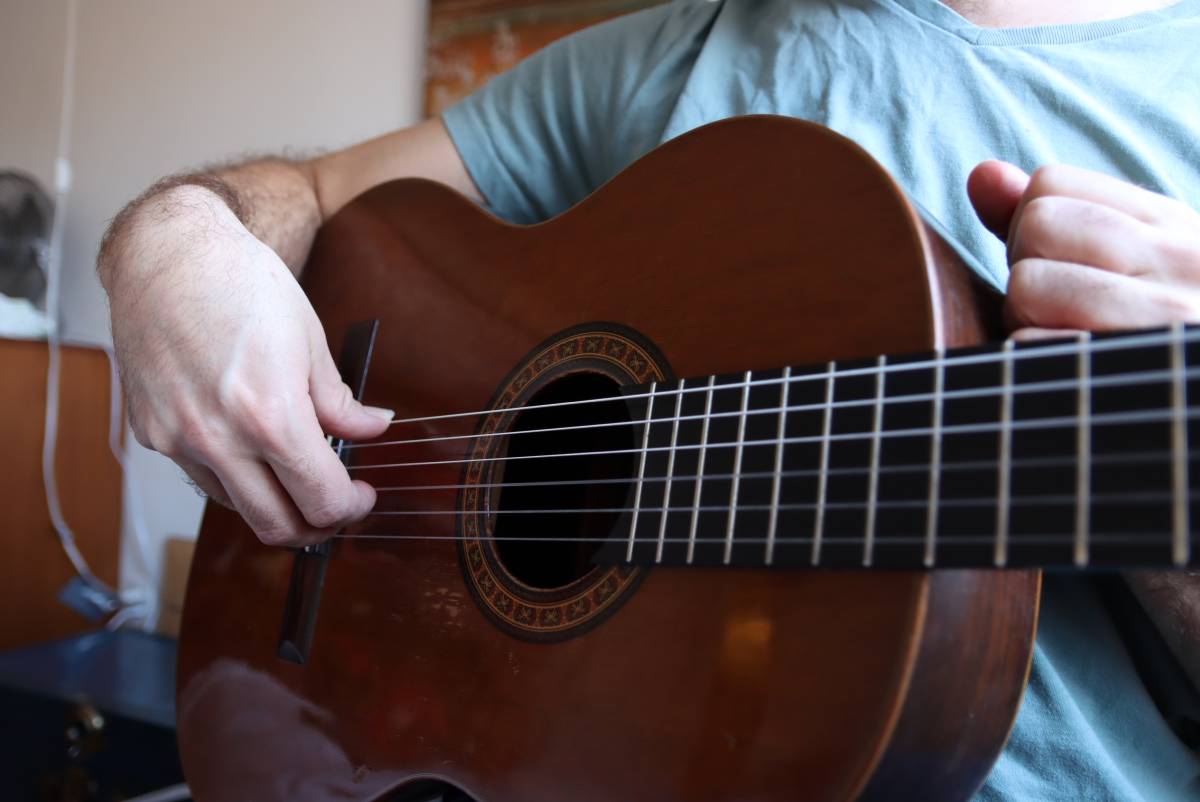
With no risk of accidentally hitting a lower-pitched string, you can play the sixth string with precision and ease.
5. Pay attention to string thickness
By feeling for the string thickness with your thumb, you'll be able to recognize the wound strings accurately without glancing at them. To begin mastering this technique, try to feel the difference in thickness between the sixth and fifth strings by touching each string with your fingertip. start by exploring the sensations of your fingers on the strings.
Now, the fifth string only has one other string above it. So you can combine this technique with the previous anchor technique to locate the fifth string with your thumb.
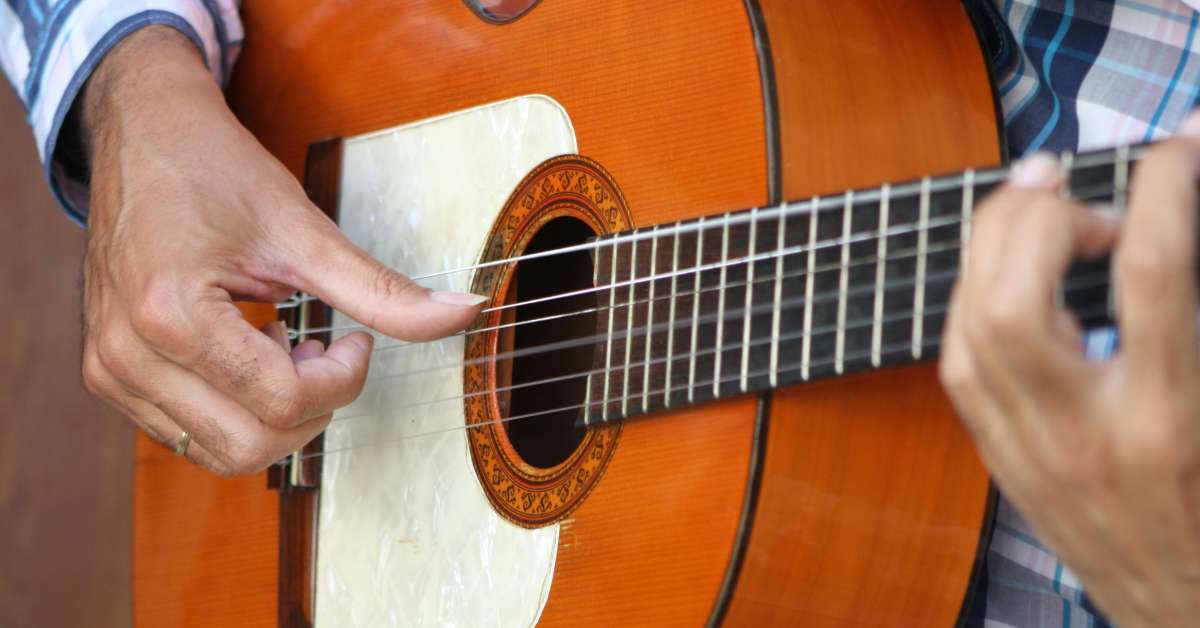
When you're trying to identify the fifth string, you can also use your thumb to feel for the sixth string, which should be right next to it. This way, you'll know you've got the right string when you feel its neighbour.
Next, try to judge the difference between the wound and unwound strings only by touching them with your fingertips. Unwound or plain strings are like soft, plush velvet; smooth and luxurious under your fingers. Wound strings, on the other hand, are more like a rougher, nubby corduroy; they will feel more stringy and less flexible. Practice plucking until you are able to distinctly feel the difference in texture between these two string types.
Once you've developed your proprioception and tactical abilities, it's time to move on to the task of improving your technique to avoid resetting your mental cues.
6. Maintain a steady hand position
If you want to avoid constantly having to look at the strings, keep a steady right hand position and avoid changing the position of your plucking hand too much. It's all about simplifying the plucking hand, keeping it steady and neutral, like I explain in the course Play Fingerstyle Guitar Now!
Also, being able to return to a neutral hand position as quickly and as naturally as possible is a huge asset. In Play Fingerstyle Guitar Now! you will learn exactly what a neutral hand position should feel and look like.

Most complex fingerstyle songs, such as music by Sungha Jung, will require you to place almost your full attention on the fretting hand. If you're bobbing your head between both hands, it's like trying to juggle while riding a unicycle while trying to keep your eyes on the pedals and the balls.
7. Practice fretting chords and playing arpeggios
All that's left now is to practice what you've learned using an exercise which involves holding a chord and playing more complex right hand fingerpicking patterns. Keep the fretting hand super simple and play the patterns without looking at your hands.
In this way, you will develop right hand independence and you will be able to concentrate on your fretting hand, which is normally tasked with more acrobatics. The reason behind only looking at the left hand when you play fingerstyle guitar is that it must cover a much larger playing distance than the right hand.
Here, I've fretted the G chord and I've placed my fingers on the sixth, third, second and first strings without looking.

As you are concentrating on one hand, try to imagine the location and placement of the other hand on the guitar. Remember what we said before about each string having a different texture. Double-check, then pluck it with your finger and check how close you were to the correct spot.
By applying these seven tips you will be the master of playing lightning-fast plucking patterns without looking at the strings or fretboard.